Why Your Jawbone Follows the “Use It or Lose It” Rule
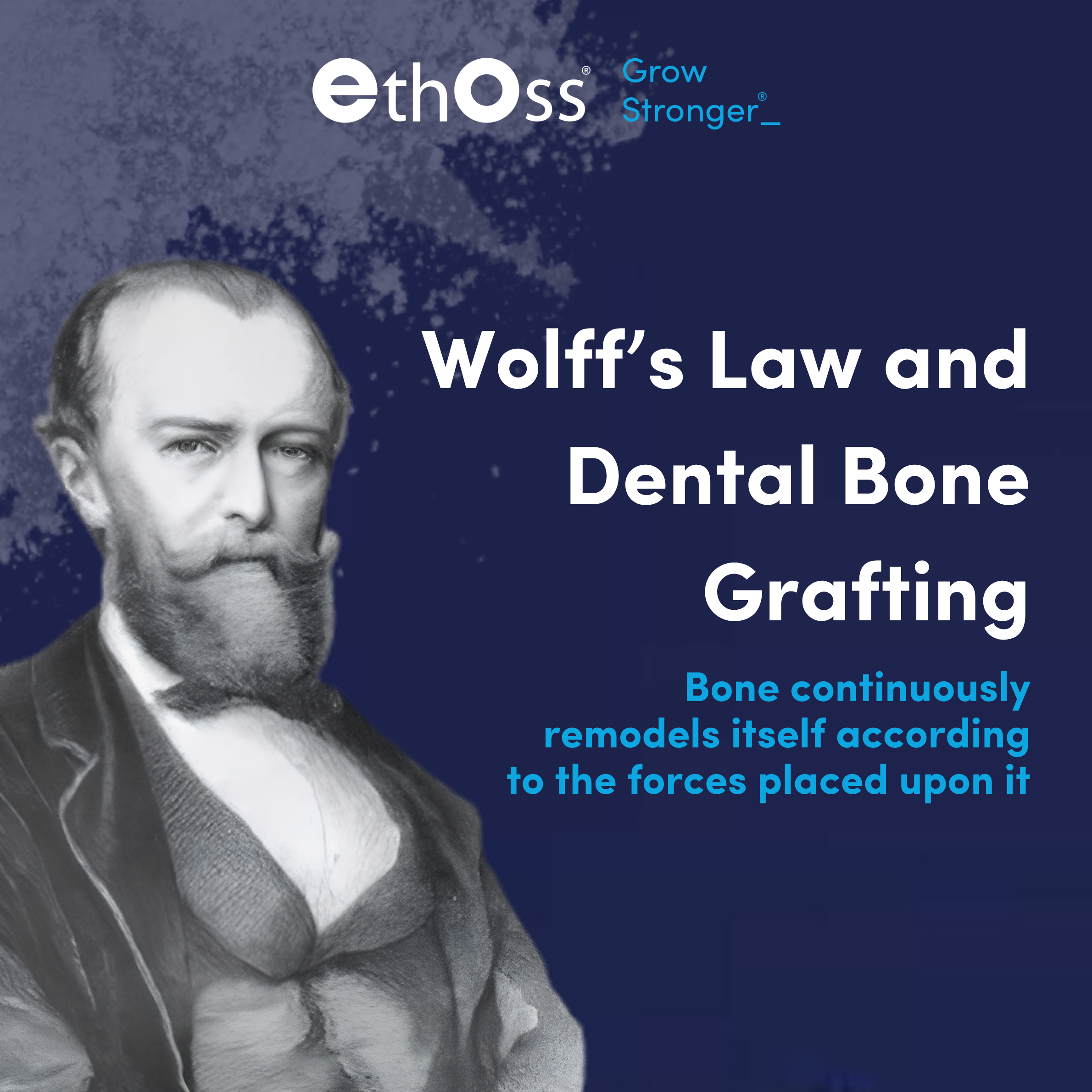
When it comes to maintaining healthy jawbone volume after tooth loss, few principles are more important than Wolff’s Law. First described by German anatomist Julius Wolff in the late 19th century, the law states that bone continuously remodels itself according to the forces placed upon it. Bones that experience regular functional loading become stronger and denser, while bones that are no longer subjected to stimulation gradually resorb and weaken. [i]
In dentistry, this concept helps explain why the jawbone often shrinks following tooth extraction and why dental bone grafting has become such an important treatment for preserving long-term oral health and implant success.
What Is Wolff’s Law?
Wolff’s Law describes the body’s remarkable ability to adapt bone structure to mechanical demands. When bone is exposed to regular stress, osteoblasts build bone tissue and strengthen the area. Conversely, when mechanical forces are reduced, osteoclasts remove bone, leading to decreased density and volume. [ii]
To put it simply, use it, and bone is maintained or strengthened, lose the stimulation, and bone begins to disappear.
This principle can be observed throughout medicine:
- Astronauts often experience bone density loss during prolonged exposure to microgravity because their skeletons are subjected to significantly less mechanical loading.
- Areas around some orthopaedic implants may experience bone loss due to stress shielding, where the implant absorbs forces that would normally stimulate the surrounding bone.
- Following tooth extraction, the absence of stimulation from the natural tooth root frequently results in significant alveolar ridge resorption.
Why Does Bone Loss Occur After Tooth Extraction?
Natural teeth do much more than help us chew. Their roots transmit forces into the surrounding alveolar bone every time we bite, chew, or clench. This ongoing stimulation signals the body that the bone is needed and should be maintained. [iii]
Once a tooth is extracted, those forces disappear. The body recognises that the bone supporting the missing tooth is no longer serving its original function. As a result, bone remodelling shifts towards resorption, causing the jawbone to shrink in both width and height. [iv]
Research has shown that the most significant dimensional changes occur during the first few months following extraction, although bone loss can continue over time if the area remains unstimulated. [iv]
The Connection Between Wolff’s Law and Dental Bone Grafting
Understanding Wolff’s Law provides a clear rationale for dental bone grafting.
Bone grafting procedures aim to preserve or rebuild bone volume in areas where bone has been lost or is expected to resorb after extraction. By placing grafting materials into the extraction socket or deficient ridge, clinicians create a scaffold that supports new bone formation and helps maintain the ridge dimensions required for future treatment. [ii]
Common reasons for bone grafting include:
- Socket preservation after extraction
- Preparing for dental implant placement
- Rebuilding areas affected by periodontal disease
- Correcting ridge defects prior to restorative treatment
- Increasing bone volume for improved aesthetics and function
By preserving the bone architecture, grafting helps reduce the extent of post-extraction collapse that naturally occurs as a consequence of Wolff’s Law.
How Dental Implants Help Maintain Bone
Dental implants provide a unique advantage over removable prostheses because they can restore functional loading to the jawbone.
Unlike dentures, which primarily sit on top of the gums, dental implants integrate directly with the surrounding bone. During chewing, forces are transferred through the implant fixture into the jaw, helping stimulate ongoing bone remodelling. [v]
This relationship is often viewed as a practical application of Wolff’s Law in implant dentistry. When properly placed and restored, implants may help preserve alveolar bone by reintroducing functional forces that would otherwise be absent after tooth loss.
However, adequate bone volume is often necessary before an implant can be placed, which is why bone grafting is frequently recommended after extraction or in areas where significant bone loss has already occurred.
Why Early Intervention Matters
Timing can make a significant difference when managing tooth loss.
The longer an extraction site remains untreated, the more bone can be lost through natural resorptive processes. This may complicate future implant placement and increase the need for more extensive grafting procedures.
Alveolar ridge preservation performed at the time of extraction is specifically designed to minimise these dimensional changes and maintain a more favourable foundation for future implant therapy. [vi]
The Takeaway: Use It or Lose It
Wolff’s Law remains one of the most important principles in understanding bone biology and dental implant treatment planning.
The jawbone relies on functional stimulation to maintain its volume and density. When a tooth is lost, the supporting bone no longer receives the mechanical signals it needs, leading to gradual resorption. Dental bone grafting and implant therapy work together to address this challenge by preserving and restoring the forces that help maintain healthy bone. [vii]
In essence, the message of Wolff’s Law is simple:
Your jawbone follows the same rule as the rest of your skeleton: use it or lose it.
Sources
- Rowe P, Koller A, Sharma S. Physiology, Bone Remodeling. StatPearls Publishing, NCBI Bookshelf. [ncbi.nlm.nih.gov]
- Avila-Ortiz G et al. Discussed in Alveolar Ridge Preservation: Why, When and How. British Dental Journal, 2019. [nature.com]
- Khalifa A et al. To What Extent Residual Alveolar Ridge Can Be Preserved by Implant? A Systematic Review. International Journal of Implant Dentistry. [pmc.ncbi.nlm.nih.gov]
- ITI Blog. Management of a Post-Extraction Dehiscence Defect Utilizing a Minimally Invasive Alveolar Ridge Reconstruction Approach, 2023. [blog.iti.org]
- Crespi R et al. Bone Remodeling Around Implants Placed After Socket Preservation: A 10-Year Retrospective Radiological Study. International Journal of Implant Dentistry, 2021. [pmc.ncbi.nlm.nih.gov]
- ITI Blog. Guidelines for Ridge Preservation: When and How, 2022. [blog.iti.org]
- Khalifa A et al. To What Extent Residual Alveolar Ridge Can Be Preserved by Implant? A Systematic Review. International Journal of Implant Dentistry. [pmc.ncbi.nlm.nih.gov]
Nature. Mechanical Regulation of Bone Remodeling, 2022. [nature.com]