Avoid These Common Preparation Mistakes
EthOss ( 65% B-tcp , 35% calcium sulfate) is engineered to provide a highly controlled environment for bone regeneration. However, it's performance depends heavily on how it is prepared before application.
Common preparation issues include:
- Incorrect liquid-to-powder ratio
- Inadequate mixing time
- Uneven consistency (overly dry or overly wet)
- Use of inappropriate mixing solutions
- Delayed application after preparation
These errors can significantly alter the handling characteristics, structural integrity, and biological performance of the graft.
If the graft is too dry, it may not adapt well to the defect site, there may be poor contact with surrounding bone which can lead to an increased risk of displacement.
If the graft is too wet, it can lead to reduced mechanical stability and a higher potential for material washout which ultimately results in a loss of scaffold structure.
In both instances, the result is unpredictable graft positioning and suboptimal regeneration outcomes.
The ideal consistency ensures both moldability and structural support.
Well-prepared material should pack easily into defects and maintain the shape to provide predictable positioning.
Best Practises for Mixing EthOss Synthetic Bone Graft
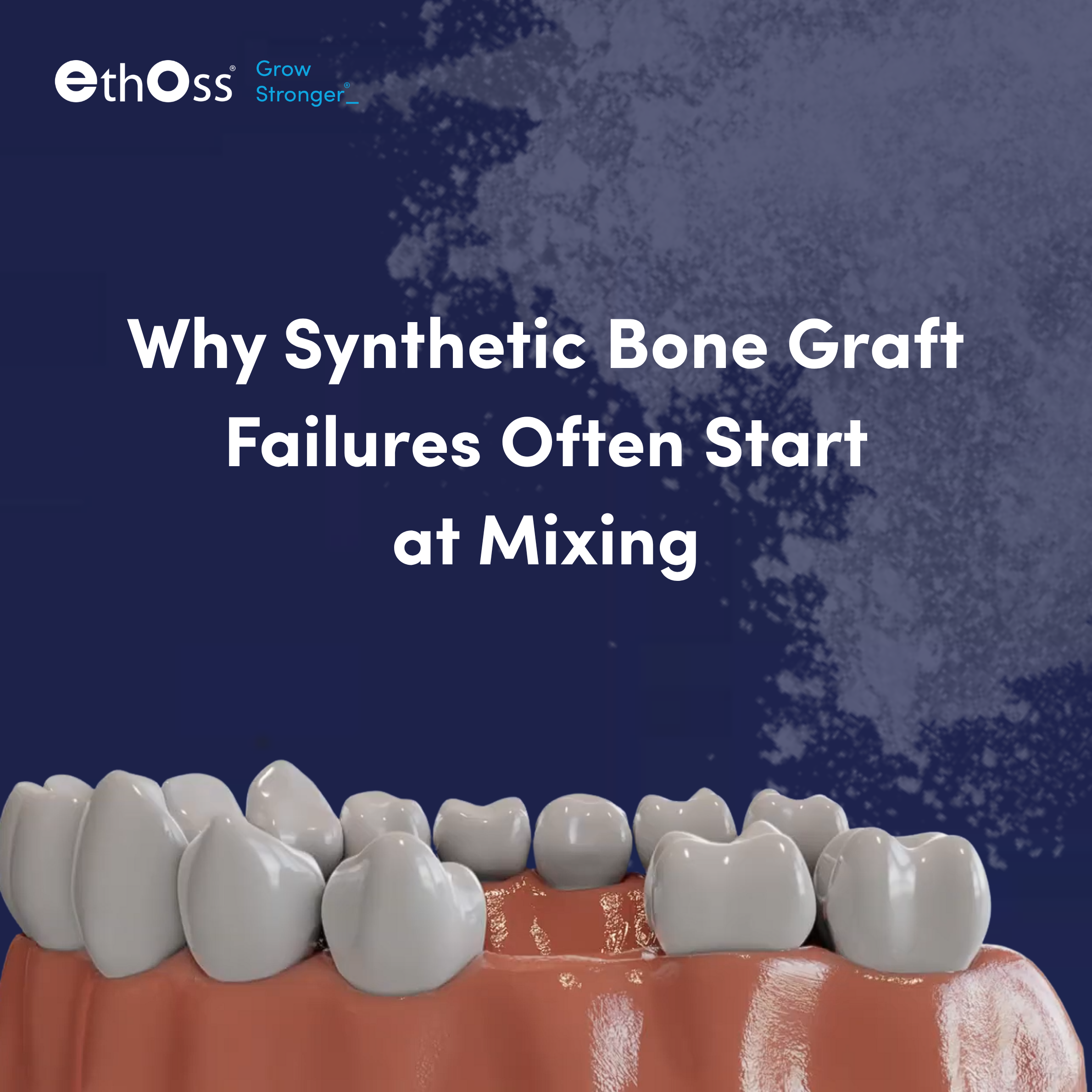
EthOss is designed for reliable and predictable dental bone grafting, but the outcome for the patient starts in the mixing stage.
For case studies displaying EthOss in real clinical applications, see here.