Dental implant therapy has evolved significantly over the past decade, particularly with the advancement of regenerative materials and techniques. One of the most debated topics among clinicians remains: should implants be placed immediately after extraction, or is delayed placement still the gold standard?
With modern regenerative approaches, the answer is no longer one-size-fits-all. In this article, we break down the differences between immediate and delayed implant placement and what the latest evidence suggests when combined with bone regeneration.
What Is Immediate vs Delayed Implant Placement?
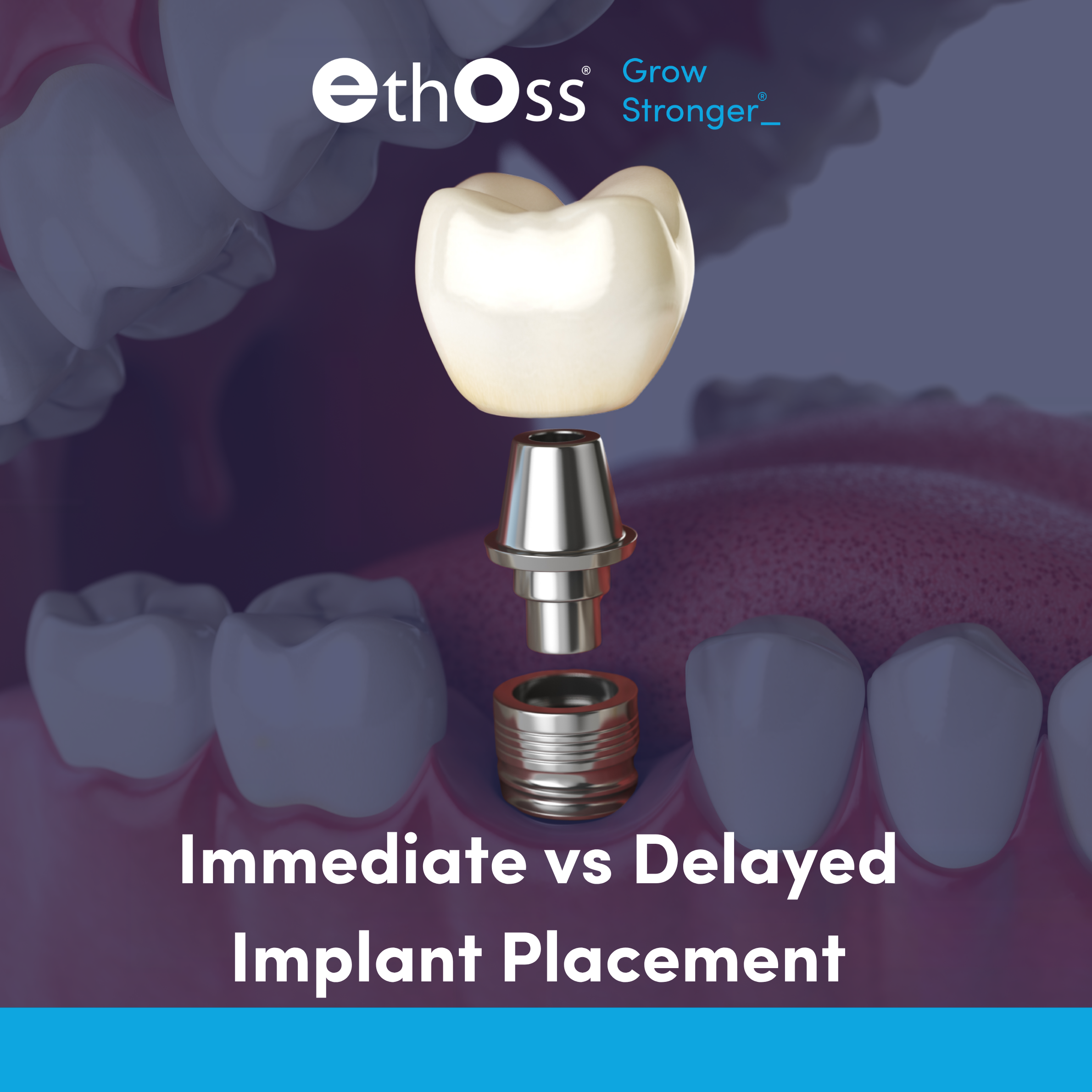
Immediate implant placement refers to the procedure wherein the implant is placed at the same appointment as tooth extraction.
With a delayed implant placement, the site is allowed to heal (typically 8-16 weeks or more) before implant placement, often with regeneration/grafting performed beforehand.
Both approaches can produce successful outcomes, but the clinical conditions and regenerative strategy play a crucial role in determining result predictability.
The Role of Bone Regeneration in Implant Success
Regardless of timing, bone volume and stability are critical for long-term implant success. Tooth extraction often leads to rapid bone resorption, particularly in the first 3-6 months.
Regenerative bone grafting aim to:
- Preserve ridge dimensions
- Support implant stability
- Improve aesthetic outcomes
- Reduce the need for more invasive procedures later
This is where modern synthetic grafting solutions are changing clinical workflows, enabling clinicians to achieve predictable outcomes in both immediate and delayed scenarios.
Immediate Placement: Advantages and Challenges
✅ Benefits
- Reduced treatment time: Fewer appointments and faster restoration
- Preservation of soft tissue architecture: Particularly important in the aesthetic zone
- Improved patient experience: Less overall surgical intervention
⚠️ Challenges
- Primary stability can be harder to achieve
- Higher risk in compromised sockets (infection, bone defects)
- Gap management (“jumping distance”) requires effective grafting
Regeneration plays a key role in immediate placement by filling peri-implant gaps, supporting new bone formation around the implant and reducing the need for additional barrier membranes. This preserves the natural blood supply from the surrounding gums, fast-tracking the body's native healing power.
Delayed Placement: Advantages and Challenges
✅ Benefits
- Higher predictability in compromised cases
- Better control of infection and soft tissue healing
- More time for ridge preservation and augmentation
⚠️ Challenges
- Additional treatment time
- Potential for increased bone loss if not managed properly
- More surgical stages in some cases
In delayed placement, regeneration is often used to preserve ridge dimensions post-extraction, rebuild bone volume prior to implant placement and improve long-term implant stability.
What Does the Evidence Suggest?
Clinical studies consistently show that survival rates for immediate and delayed implants are broadly comparable when case selection is appropriate. It also shows that quality and quantity are more important than timing of the implant placement.
We have many case studies from our clinicians who consistently utilise EthOss within their implant procedures and the main takeaway is that regenerative techniques significantly improve outcomes in both approaches.
In other words, success is less about when the implant is placed and more about how well the site is managed biologically.
Case Selection: The Deciding Factor
Choosing between immediate and delayed placement depends on key clinical factors and clinician preference.
Immediate placement is ideal when:
- The socket is intact with minimal bone loss
- There is no acute infection
- The clinician can manage the peri-implant gap predictably
Delayed placement is preferred when:
- There is significant bone loss or defect
- Infection is present
- Soft tissue conditions are unfavourable
- Additional augmentation is required
Conclusion
The debate between immediate and delayed implant placement is no longer about which is “better” but rather which is more appropriate for the specific clinical scenario.
By combining the right timing strategy with effective regenerative techniques, clinicians can deliver more predictable, efficient, and patient-friendly implant treatments.
To view our immediate case studies, visit our immediate case studies
To view our delayed placement case studies, visit our delayed case studies